War Dog Ceremony
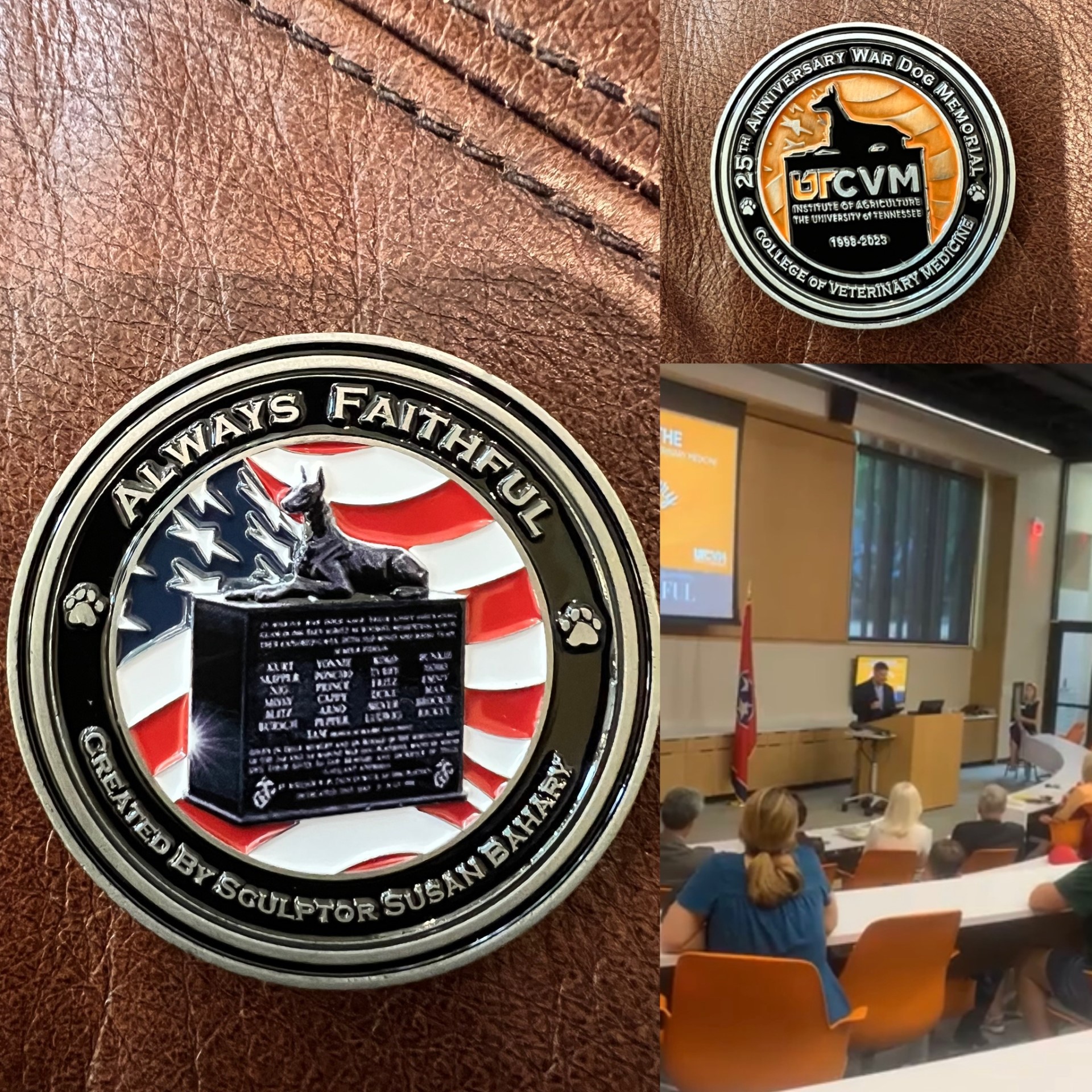
The Center was honored to be invited to participate in the War Dog Ceremony at the UTK Veterinary College of Medicine on Saturday, July 15, 2023.
Center Director Dr. Chris Magra talked about World War II and the history of war dogs. The U.S. Army officially started its K-9 Corps on March 13, 1942, in the midst of WWII. One week after the attack on Pearl Harbor in December 1941, Japanese forces captured the island of Guam, which had been a U.S. territory since 1898. The U.S. decided to take Guam back, along with other Pacific islands the Japanese had occupied. We launched Operation Forager in 1944. 59,000 U.S. troops, including K-9 teams, the Marines, the Army, the Navy, and even the Coast Guard took Guam back. Doberman pinschers such as the one featured on the War Dog Memorial were part of the K-9 teams. 3,000 U.S. troops and 18,000 Japanese soldiers lost their lives in the battle. 25 war dogs gave their lives to liberate the island, as well. They served as sentries, messengers, and scouts. They explored jungles and caves, and they detected mines and booby traps.
A few months after the liberation of Guam, Admiral Chester Nimitz, the commander in chief of Pacific Ocean Areas, established the island as his headquarters for the remainder of WWII. The strategic location of Guam allowed American land-based bomber crews, for the first time, to make round-trip strikes directly at the Japanese home islands. This turned the tide of the war in the Pacific. The Japanese formally surrendered in 1945, one year after we retook Guam.
In 1994, the Marines established a monument in Guam for their war dogs. The engraving on the memorial reads: “Given in their memory and on behalf of the surviving men of the 2nd and 3rd Marine war dog platoons, many of whom owe their lives to the bravery and sacrifice of these gallant animals.”
Four years later, in 1998, a replica of that very memorial in Guam was established at the University of Tennessee’s College of Veterinary Medicine in Knoxville as a permanent memorial in honor of the war dogs, their handlers, and the veterinary profession, and to the unique human bond with “man’s best friend.” We gathered to celebrate the 25th anniversary of the establishment of this memorial.