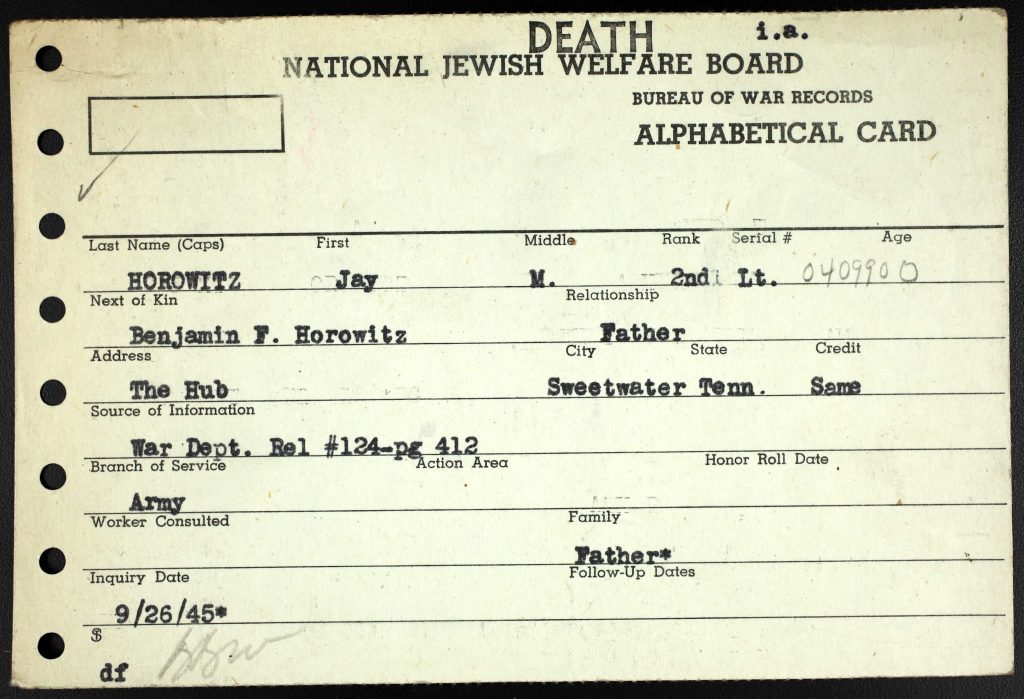
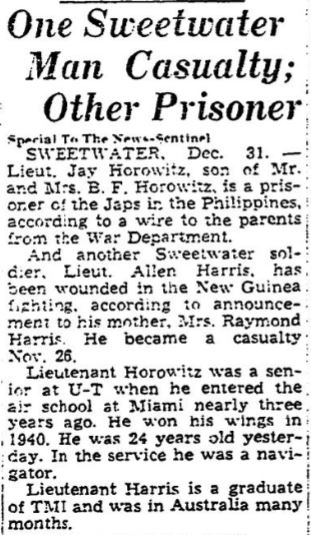
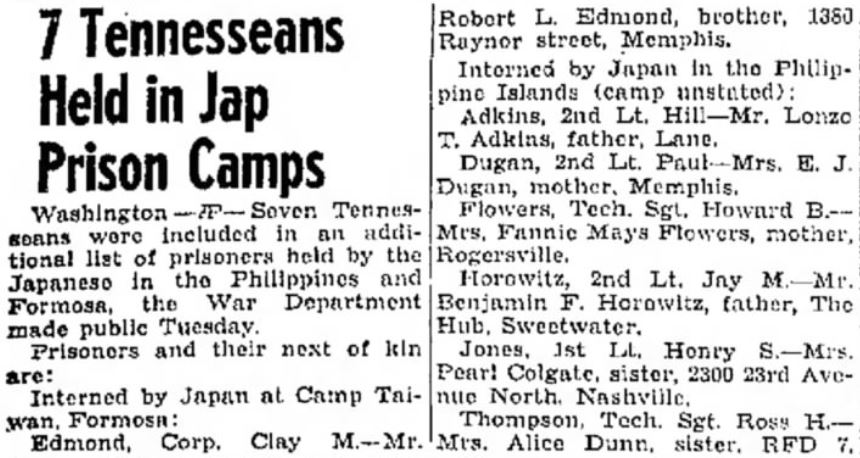
Jay Malcomb Horowitz
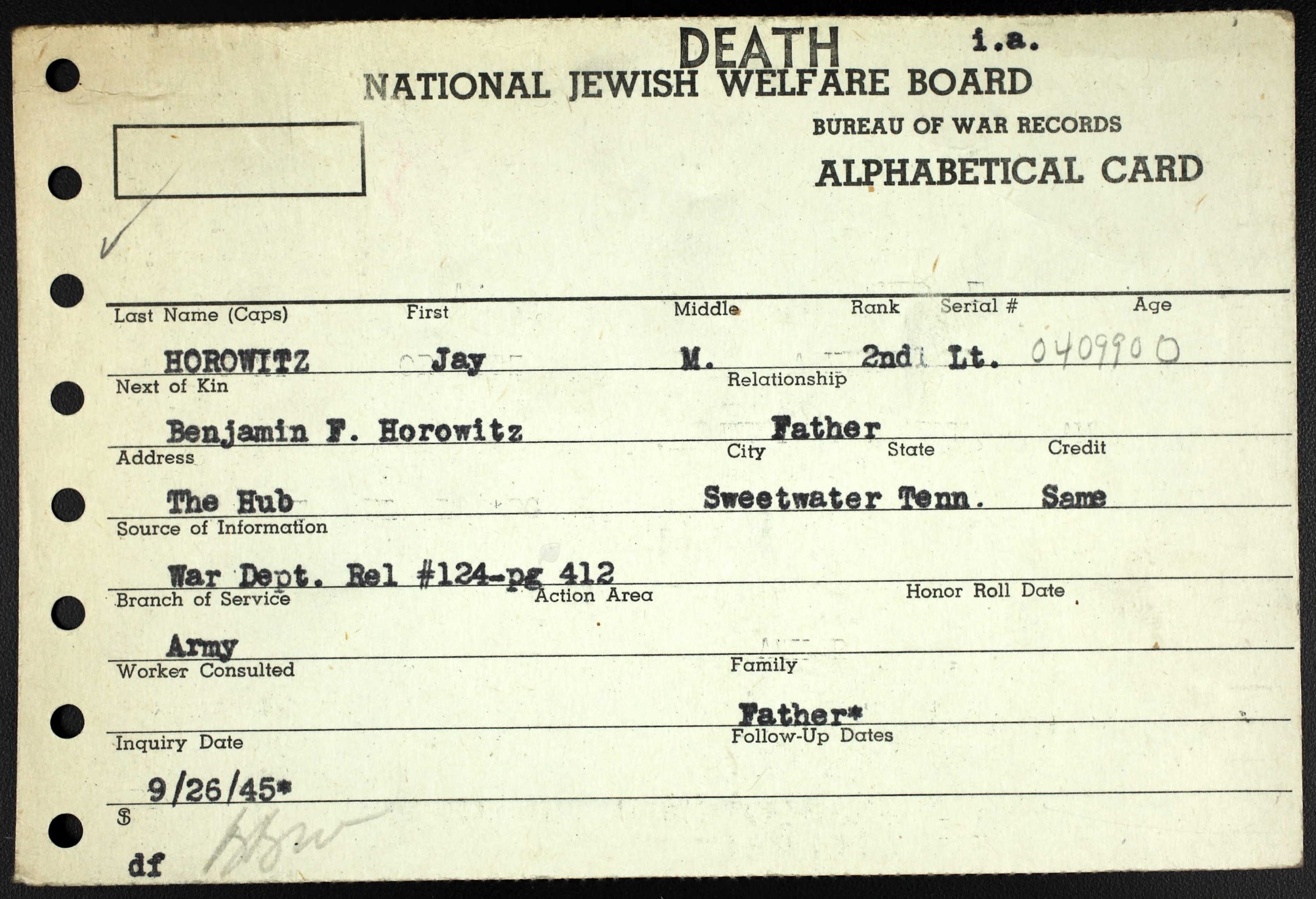
Rank: 2nd Lieutenant
Branch: Army Air Corps
UT Major/Affiliation: Business Administration 1937-1940
Hometown: Sweetwater, TN
- Dec. 30, 1918 – Jan. 23, 1945
- From Sweetwater, TN, but born in Brooklyn, New York
- Business Administration 1937-1940
- Senior when he enrolled in the University of Miami’s pilot program
- 2nd Lt – Army Air Corps
- 93rd Bomb Sqdn, 19th Bomb Grp. POW in the Philippines. Bataan Death March. Cabanatuan Prison Camp. Transported on hellships Enoura Maru, Brazil Maru, and Oryoka Maru, where he died. Body was tossed in the sea.
- Flew B-17s out of Clark Air Base at the start of 1941 before the United States entered the war
- Did not evacuate to Australia. Instead, remained with the army to assist in the defense of the Philippines
- Memorialized at Manila American Cemetery in Manila, Philippines
Jay Malcomb Horowitz (Dec. 30, 1918 – Jan. 23, 1945) was born in Brooklyn, New York, but raised in Sweetwater, Tennessee. He attended the University of Tennessee for Business Administration from 1937 to 1940. Before the United States entered the war as a result of the Japanese attack on Pearl Harbor, Horowitz enrolled in the University of Miami’s pilot training program during his senior year at UT. He was trained on B-17 bombers there with classmates who included Doolittle Raiders and other Army Air Corps pilots already on active duty at the start of the war. He was commissioned as a 2nd Lieutenant and deployed with the 93rd Bomb Squadron of the 19th Bomber Group to Clark Air Field in the Philippines at the start of 1941.
He was stationed at Clark Air Field when the Japanese Imperial Army invaded in December 1941 after the attack on Pearl Harbor. The Army Air Corps began evacuating to Australia, but 2nd Lt. Horowitz chose to stay behind and help the Army as it defended against the Japanese. He was among the last of the US armed forces to surrender in April 1942. As a prisoner of war, 2nd Lt. Horowitz endured the infamous Bataan Death March, the Cabanatuan Prison Camp, and the Bilibid Prison Camp in Manila. He was also a prisoner onboard the Oryoku Maru transport ship when it was attacked by US planes from the USS Hornet in December 1944 during an attempted transfer of prisoners out of the Philippines. He and the other prisoners were later transferred to Formosa on December 27, 1944, and then to Japan on January 23, 1945, on the Brazil Maru. 2nd Lt. Horowitz died from the conditions of his captivity during this final transfer of PoWs while at sea and en route to the Japanese mainland. He is memorialized at the Manila American Cemetery in the Philippines